



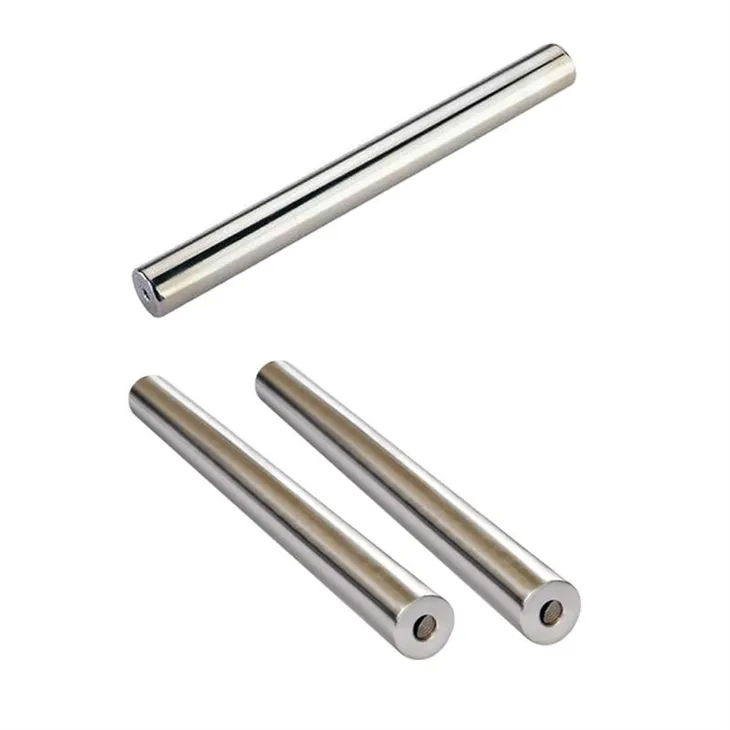


Product Descriptions
D22 D25 mm NdFeB Filter Rods – Compact Diameter, High Capture Efficiency
Technical Specifications – D22 D25 mm NdFeB Filter Rods
The table below summarizes key parameters for our D22 D25 mm NdFeB filter rods. Custom lengths and end fittings are available.
| Parameter | D22 mm Rod | D25 mm Rod |
|---|---|---|
| Tube Diameter (OD) | 22 mm (0.866") | 25 mm (0.984") |
| Surface Magnetic Flux (peak) | 11,500 – 12,000 GS | 12,000 – 12,500 GS |
| Magnet Material (standard) | NdFeB N48SH (max 150°C) | NdFeB N48SH (max 150°C) |
| High‑Temp Option (SmCo) | 8,500 GS, max 250°C | 8,500 GS, max 250°C |
| Tube Material & Finish | 316L seamless, electropolished (Ra ≤ 0.4 μm) | 316L seamless, electropolished (Ra ≤ 0.4 μm) |
| Standard Magnetic Lengths (L) | 200, 300, 400, 500, 600, 800, 1000, 1200 mm | 200, 300, 400, 500, 600, 800, 1000, 1200 mm |
| End Fittings Options | M8 stud, eye bolt, tri‑clamp (1.5"), countersunk hole | M8 or M10 stud, eye bolt, tri‑clamp (1.5" or 2") |
*Custom lengths from 100 mm to 1000 mm available. Contact us for non‑standard diameters (20 mm, 28 mm, etc.).


Why Choose 22 or 25 mm Diameter Rods
Space‑Efficient Design
The 22 mm and 25 mm diameters allow installation in narrow chutes or between existing equipment frames where 32 mm rods would not fit. Despite the smaller size, magnetic field depth remains sufficient for most free‑flowing materials.
High‑Intensity NdFeB Core
Our sintered N48SH grade (Br 1.38‑1.42 T, Hcj ≥ 1590 kA/m) provides excellent resistance to demagnetization and maintains performance up to 150°C. The Halbach array focuses flux outward, achieving 12,000 GS at the tube surface.
Easy Integration & Cleaning
Electropolished 316L tubes prevent material adhesion. Threaded ends allow quick mounting via nuts or brackets. For sanitary lines, tri‑clamp ends enable fast removal for cleaning or inspection.
Application
Magnetic filter bars are highly effective for applications including:
Removing ferrous contaminants from liquids and slurries
Processing food products such as sauces, syrups, and beverages
Treating chemical slurries and ceramic glazes
Separating metal impurities from plastic pellets and powders
Cleaning grain, sugar, seasonings, and high-purity powders
These filter bars are commonly installed to safeguard:
Pumps, mixers, extruders, valves, centrifuges, and filling machines.

Quality Built on Full‑Process Control
Our vertical integration ensures consistent quality for every D22 D25 mm NdFeB filter rod. The process begins with vacuum induction melting of virgin neodymium, iron, boron, and dysprosium (for N48SH grade). After jet milling to 3‑5 μm powder, the material is pressed in a magnetic field, sintered, and heat‑treated to achieve high intrinsic coercivity. The magnets are then precision ground, assembled into Halbach arrays, and inserted into 316L tubes. Automated TIG welding in an inert atmosphere seals the ends, followed by electropolishing and passivation. Each rod is then 100% tested: gauss mapping with a motorized Hall probe at 5 mm intervals, pressure leak test (for liquid service), and visual inspection of weld and surface finish. Salt‑spray samples are run per ASTM B117 to validate corrosion resistance. We provide a test certificate with gauss profile graph for every batch. Our IATF 16949 and ISO 9001 systems ensure full traceability from raw material to finished rod.

Packaging & Logistics – Ready for Global Shipment
Each rod is individually wrapped in anti‑static foam and secured in a plywood crate or reinforced carton with internal dividers to prevent bending. Standard sizes ship within 7‑10 days; custom lengths 12‑15 days after drawing approval. Free samples available for qualified projects. We export worldwide with full customs documentation.
FAQ
Q1: What is the main magnetic performance difference between D22 and D25 mm NdFeB filter rods?
A1: A D25 rod has a larger core volume, allowing a higher grade or more magnetic material. For the same length and grade (e.g., N42), the D25 rod typically achieves 12,000–13,500 GS surface field, while D22 gives 10,500–12,000 GS. However, the D22 has a smaller outer radius, creating a steeper field gradient that captures very fine (<5 µm) particles slightly better near the surface.
Q2: How does the outer diameter affect the pressure drop across a bank of filter rods?
A2: Larger diameter rods (D25) block more flow area, increasing pressure drop by 25–40% compared to D22 at the same center‑to‑center spacing. For viscous fluids (oil, syrup), use D22 rods to keep flow rates above 100 L/min per row. For dry powders (flour, plastic pellets), D25 rods are acceptable because air has low viscosity.
Q3: Can I replace a D22 filter rod with a D25 rod in an existing magnetic trap?
A3: Only if the housing and mounting holes support the larger diameter. D25 rods need wider gaps between rods and a larger bore tube. Forcing a D25 into a D22 pocket may jam or damage the stainless steel sleeve. If your trap uses threaded ends, the thread size also differs (M8 vs M10 typically). Measure first.
Q4: Which grade of NdFeB is optimal for D22 and D25 filter rods in wet slurry applications?
A4: For wet slurry (e.g., ceramic glaze or mining), use N42SH or N40SH (150°C max) because friction can raise local temperature. D22 rods with SH grade deliver ~11,500 GS; D25 with same grade gives ~13,000 GS. Avoid N52 in wet conditions – its low Hcj risks irreversible demagnetization from abrasive particle impacts.