



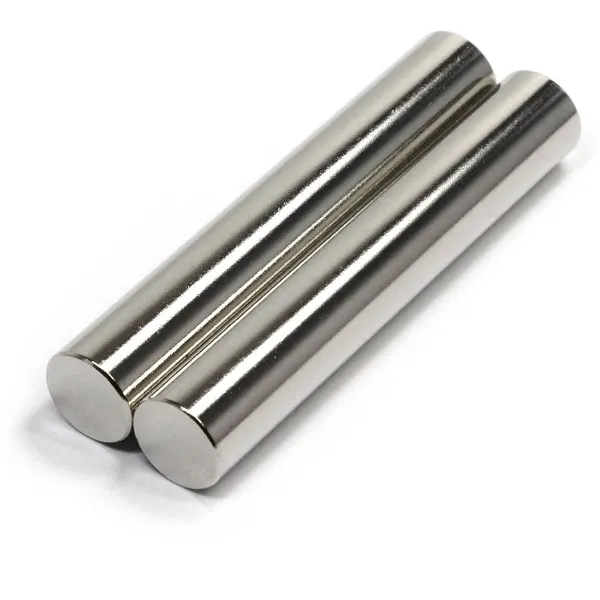


Product Descriptions
Technical Specifications – Magnetic Powerful Filter Bar
The table below lists standard configurations. Custom lengths, diameters, and end fittings are available with short lead times.
| Parameter | Standard Options |
|---|---|
| Surface Gauss (peak) | 12,000 ± 500 GS (N48SH core); 8,500 GS for SmCo high‑temp版本 |
| Magnetic Material (standard) | Sintered NdFeB N48SH – Max 150°C, Hcj ≥ 1590 kA/m |
| High‑Temp Option | SmCo 2:17 – Max 250°C, lower gauss (≈8,500 GS)但耐温更高 |
| Housing Material | 316L seamless stainless steel, electropolished (Ra ≤ 0.4 μm) |
| Standard Diameters | 25 mm (1") or 32 mm (1.25") |
| Lengths (magnetic zone) | 200, 300, 400, 500, 600, 800, 1000, 1200 mm; custom up to 1500 mm |
| End Fittings | Tri‑clamp (1.5" or 2"), M8 stud, eye bolt, countersunk hole, or fixed flange |
| Certifications | IATF 16949, ISO 9001, FDA 21 CFR 178.3570, RoHS, REACH |


Why Choose a High‑Intensity Magnetic Filter Bar
Exceptional Capture Efficiency
The magnetic powerful filter bar generates a gradient field that attracts and retains ferrous particles even at high flow velocities (up to 2 m/s for liquids, 15 m/s for air). This reduces downstream equipment wear and prevents product recalls.
Fully Welded & Leak‑Tight
Our automated TIG welding in inert gas atmosphere ensures no crevices or pinholes. Each bar is pressure‑tested (10 bar for liquid service) and dye‑penetrant inspected, eliminating any risk of magnet contamination to the product stream.
Easy Clean & Certification Ready
Electropolished finish prevents product buildup and allows simple wipe‑down or CIP (clean‑in‑place) procedures. All materials are FDA‑compliant (21 CFR 178.3570), and we provide full documentation for audits.
Application
Magnetic filter bars are highly effective for applications including:
Removing ferrous contaminants from liquids and slurries
Processing food products such as sauces, syrups, and beverages
Treating chemical slurries and ceramic glazes
Separating metal impurities from plastic pellets and powders
Cleaning grain, sugar, seasonings, and high-purity powders
These filter bars are commonly installed to safeguard:
Pumps, mixers, extruders, valves, centrifuges, and filling machines.

Quality Assurance – Full Process Control from Raw Material to Finished Bar
Our integrated facility controls every step: vacuum induction melting of virgin neodymium, iron, boron (and dysprosium for N48SH grade), jet milling to 3‑5 μm powder, pressing in a magnetic field, sintering, and heat treatment to achieve high intrinsic coercivity. The magnets are then precision ground, assembled into Halbach arrays, and inserted into the 316L tube. The tube ends are TIG welded in a class 1000 cleanroom to prevent oxidation. After welding, each assembly is electropolished and passivated. Every magnetic powerful filter bar undergoes a 100% gauss mapping test using a motorized Hall probe scanner that records field strength at 5 mm intervals along the bar and around its circumference. We also perform pressure decay leak tests (for liquid bars) and salt‑spray corrosion tests (ASTM B117) on sample batches. Our ISO 9001 and IATF 16949 systems ensure full traceability from raw material lot to finished product. All shipments include a test certificate with gauss profile graph.

Packaging & Logistics – Ready for Global Shipment
Each bar is individually wrapped in anti‑static foam and placed in a sturdy plywood crate or heavy‑duty carton with internal separators to prevent bending. For long bars (>1000 mm), we add end caps and corner protection. Lead times: standard sizes 10‑14 days, custom lengths 18‑22 days after drawing approval. Free samples available for evaluation (shipping fee applies). We export worldwide with full customs documentation.
FAQ
Q: What is a Magnetic Powerful Filter Bar and where is it commonly used?
A: A magnetic powerful filter bar is a tube‑encased neodymium magnet assembly, typically round or square, designed to extract ferrous contaminants from dry powders, slurries, or liquids. Common uses: food processing (chocolate, flour), plastics recycling, ceramic slip, and hydraulic oil. Surface field ranges 8,000–13,500 GS.
Q: How does the magnetic circuit design affect the capture zone of a filter bar?
A: A bare magnet has scattered flux. A powerful filter bar uses a steel pole piece and a non‑magnetic stainless steel tube (304/316L) with optimized wall thickness (0.5–1.5 mm). This concentrates flux on the tube surface, creating high‑gradient zones that capture particles down to 1 µm. Without proper circuit design, the bar loses 30–50% efficiency.
Q: What is the maximum operating temperature for a standard Magnetic Powerful Filter Bar?
A: Standard NdFeB bars (N35–N45) work up to 80°C. Above that, magnetic field drops irreversibly. For hot applications (e.g., asphalt, frying oil), specify high‑temperature grade: N40SH (150°C) or SmCo (250°C). Also check that the stainless tube and end welds tolerate thermal expansion. Never use ferrite bars for "powerful" claims – they are weaker.
Q: Can a Magnetic Powerful Filter Bar be cleaned easily without losing magnetism?
A: Yes. Cleaning requires sliding the bar out of the product flow and wiping or rinsing off captured sludge. Never hammer or heat above 80°C (damages NdFeB). For easy cleaning, choose a bar with a smooth 316L sleeve and a ring handle. Magnetic strength remains unchanged if cleaned before sludge bridges across the bar.
Q: Why does a longer Magnetic Powerful Filter Bar not always mean better filtration?
A: Doubling length doubles the capture area only if flow passes perpendicularly across the bar. In parallel flow (along the bar axis), the first 50–100 mm captures most particles; downstream sections see already‑clean fluid. For high efficiency, use multiple staggered short bars (grid arrangement) rather than one very long bar.